General
What outcome-based marketing means
KIZUNA Team ·
What outcome-based marketing means
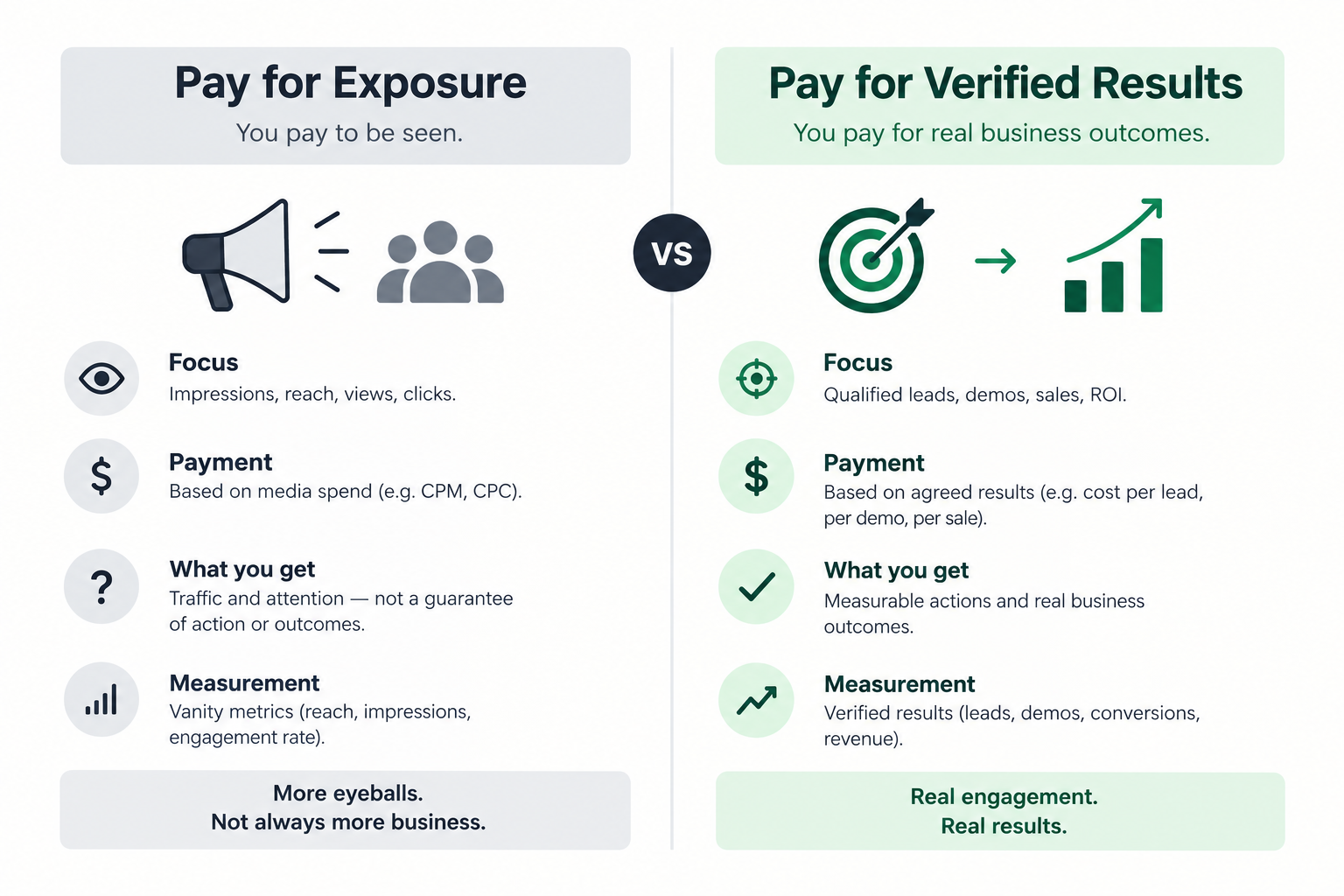
You and your marketing partner agree in advance on what counts as a result and what it is worth. A result could be a verified sign-up, a completed first transaction, a confirmed store visit, or a qualified lead. The campaign runs. You pay when a result is confirmed, not when an ad is shown or an event is held.
The idea is not new. Digital advertising has long sold on a cost-per-action basis, where the advertiser pays for a defined action such as a sale or a sign-up. Outcome-based marketing applies the same logic more widely, including to work done in the field.
How it compares with media spend
- What you pay for. Media spend buys opportunity: a place on a screen, a slot on air, a spot on a billboard. Outcome-based pricing buys the result itself.
- Who carries the risk. With media spend, you pay first and the result is your problem. With outcome-based pricing, the partner carries more of the delivery risk, because they are paid when the result happens.
- Budget behaviour. Media spend is fixed and the results vary. Outcome-based spend varies and the cost per result is the stable number you negotiate.
- What you learn. Media reports tell you what was served. Outcome reports tell you what happened.
A simple illustration, with invented numbers: a brand spends KES 500,000 on a media flight. It cannot know in advance how many people will install its app.
Under an outcome model, the same brand agrees to pay KES 500 per verified install. A budget of KES 500,000 could fund up to 1,000 confirmed installs. If the partner delivers 600, the brand pays KES 300,000 for those 600 verified installs, assuming no other fees.
Where the risk really sits
Outcome-based marketing is not risk-free, and any partner who says so is selling. Four risks matter:
- Cost per result is not cost per impression. An outcome costs more than a view, because it is worth more. Compare cost per outcome with what you currently pay per customer, not per thousand impressions.
- Definitions can be argued. If "a lead" is vaguely defined, both sides will disagree later. Define the result precisely before you start.
- Fake results. Pay-per-lead and pay-per-action models invite fraud, such as fake leads and padded numbers, when nothing checks the result. The model is only as honest as its verification.
- Attribution. Did the campaign cause the result, or would it have happened anyway? This needs sensible baselines and clean tracking.
Waste in conventional media is also real. An American industry study of the programmatic open-web ecosystem, as cited by one outcome-based ad platform, estimated that about $22 billion of $88 billion was lost to waste and fraud in a year. That figure is for the US programmatic market, not Kenya, but it shows why advertisers are asking harder questions about what their money buys.
How to measure outcomes properly
Good measurement is what makes paying per result safer. Use five steps:
- Define the outcome. One action, described in a sentence anyone can check.
- Set the price. Decide what a confirmed outcome is worth to you, based on lifetime value or the cost of acquiring a customer by other routes.
- Verify every result. Confirm each outcome against a reliable source, such as a transaction record, a tracked install, or a checked submission, and not only a self-report.
- Check quality. Count what happens next: did the person come back, make a second purchase, stay active? A cheap outcome that never returns is not cheap.
- Report cost per verified outcome. This is the number to compare against every other channel.
For app campaigns, install-level tracking usually needs a dedicated attribution tool, as general website analytics will not do the job. Plan the tracking before the campaign, not after.
When outcome-based is not the answer
Not everything can be reduced to a single measurable action. Building a brand people recognise and trust takes time, and that work makes later performance cheaper.
Marketing researchers have made this point: brand building tends to lower the cost of acquiring customers over time, while performance spending delivers this quarter's results. Most brands need both.
Use outcome-based pricing where you can name the result, verify it, and put a value on it. Keep awareness spending for the long game.
How KIZUNA applies this
KIZUNA Activate is built around outcomes. Brands are connected with verified participants who complete defined tasks, in the field or online, and results are confirmed before they count. The aim is simple: a brand should know what it paid for, and be able to check it.
If you are weighing a campaign and want to price it by result rather than by exposure, talk to the KIZUNA team about defining the outcome, the price and the proof.
Sources and links:
- Realize, "What Is Outcome-Based Advertising?": https://realize.com/marketing-hub/outcome-based-advertising/
- Wikipedia, "Cost per action" (pay-per-lead models and fraud risk): https://en.wikipedia.org/wiki/Cost_per_action
- Blockboard announcement citing the ANA Programmatic Media Supply Chain Transparency Study ($22B of $88B): https://martechseries.com/tv-advertising/blockboard-revolutionizes-outcome-based-marketing-with-a-performance-based-ctv-ad-platform/
- Enrich Labs, "Performance Marketing: Complete Guide 2026" (references the HBR argument on brand building and performance marketing): https://www.enrichlabs.ai/blog/performance-marketing-complete-guide-2026
- HBR, "How Brand-Building and Performance Marketing Can Work Together:https://hbr.org/2023/05/how-brand-building-and-performance-marketing-can-work-together